
How to Discover New Music Without Infinite Scroll
Follow one relationship at a time: credit, label, scene, influence or live bill; then stop after three candidates.
How do you turn searching into one useful listen?
Use credits, label catalogues, local scenes and three-candidate limits to discover new music without surrendering to infinite scroll.
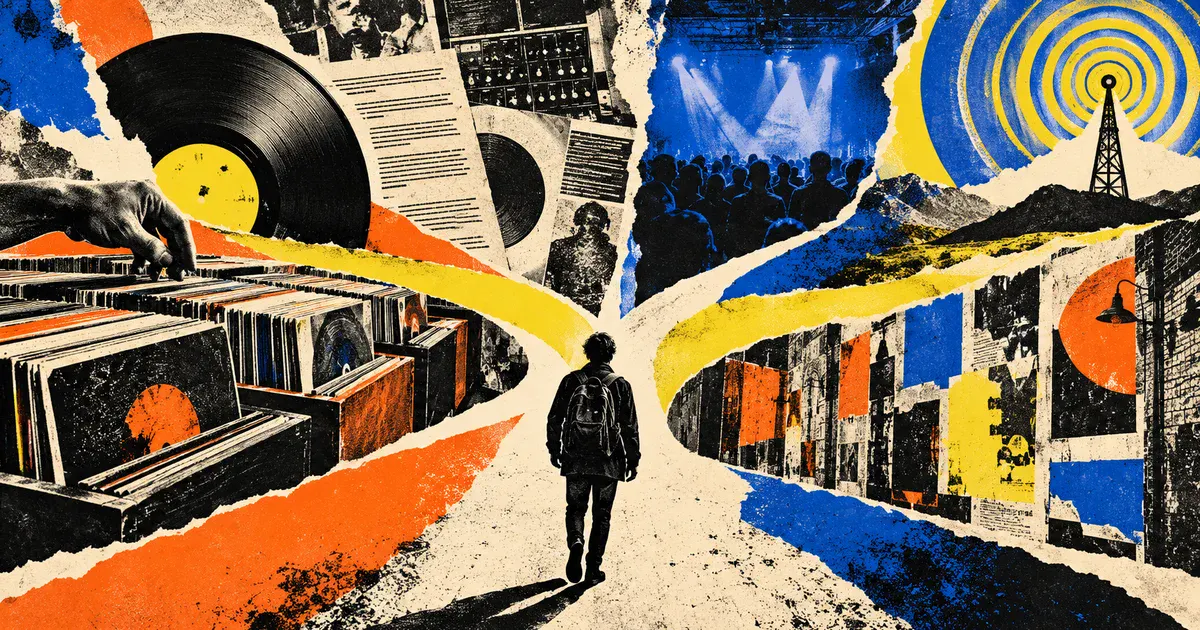
Three-route discovery session
- Choose one recording and name what you value in it.
- Find one candidate through a credit, one through a label, and one through a scene or bill.
- Hear one full track from each candidate.
- Choose one full release and record the relationship that justified it.
Start from evidence
Pick one track you already understand. Open its credits and choose a person whose contribution you can hear: producer, mixer, featured player or songwriter. Follow that person to one other recording. This creates an audible reason for the recommendation.
A label catalogue offers a different route: compare releases from the same two-year window and ask which production values or scenes recur.
Write the relationship beside every candidate as soon as you save it. Producer on the bridge, same label between 2018 and 2020, or shared venue bill is more useful than recommended from a favorite. The note gives you a listening hypothesis. If the expected connection is inaudible, keep that result too. Discovery improves when a route can fail honestly instead of turning every click into confirmation.
Use a three-candidate limit
Discovery fails when collecting replaces listening. Save no more than three candidates per session. Hear one full track from each, then choose one release for a longer listen.
Record why you saved it in ten words. If you cannot name the reason, the recommendation has not become knowledge yet.
Give each candidate the same minimum audition so fame and placement do not decide the outcome. One complete track is usually enough for the first cut, but choose a track that represents the relationship you followed. A guest appearance may not reveal an artist's own work. After three auditions, select one release and schedule a full listen. Delete or defer the others so the queue remains a decision tool rather than a storage bin.
Move sideways through a scene
Festival bills, venue archives and local radio playlists expose relationships that similarity engines often flatten. Treat genre labels as doors, not definitions: a scene can be held together by geography, collaborators, politics, equipment or audience before it is held together by sound.
Scene research benefits from moving between source types. A venue archive can show who shared a bill, a radio playlist can show who received local attention, and recording credits can show collaboration outside public performances. None alone defines the scene. When sources disagree about a boundary, describe the overlap and the disagreement instead of drawing a confident circle around people who may not have used the label themselves.
Worked example: three routes from one keyboard part
Start with a keyboard texture you can locate at a timestamp. A credit route follows the performer to another recording. A label route samples a neighboring catalogue release. A scene route checks a documented bill or local radio archive from the same period.
The three candidates may not sound alike, and that is useful. Choose the one whose relationship taught you something specific, then hear a complete release. Discovery ends with a listening decision, not an endlessly growing saved list.
What connects the stages
Known recording
Provides a concrete starting detail.
Documented relationship
Leads to a small set of justified candidates.
Full-release listen
Turns discovery into an informed choice.
Continue the route
When several candidates share a trait but not an obvious history, How to Map Music Genres by Lineage, Scene and Sound can connect them without inventing influence or fixed genre borders.
To keep the discovery trail useful after the session, record the reason for each choice with An Active Listening Notes Template That Stays Useful instead of saving unexplained links.
Where a discovery session loses its purpose
Following a famous name instead of the contribution you heard.
Saving dozens of candidates before hearing any fully.
Calling a recommendation contextual when its relationship is not explained.
Evidence and boundaries
These sources support the factual context used in this guide. The listening exercise and worked interpretation are original editorial guidance.
We do not claim private access, completed laboratory testing, or universal results. Read the music research and review methodology for the publication standard.