
How to Map Music Genres by Lineage, Scene and Sound
A useful genre map shows several kinds of relationship and states what evidence supports each connection.
What should a useful genre map actually show?
Map genres by lineage, scene and musical trait without pretending the borders are fixed.
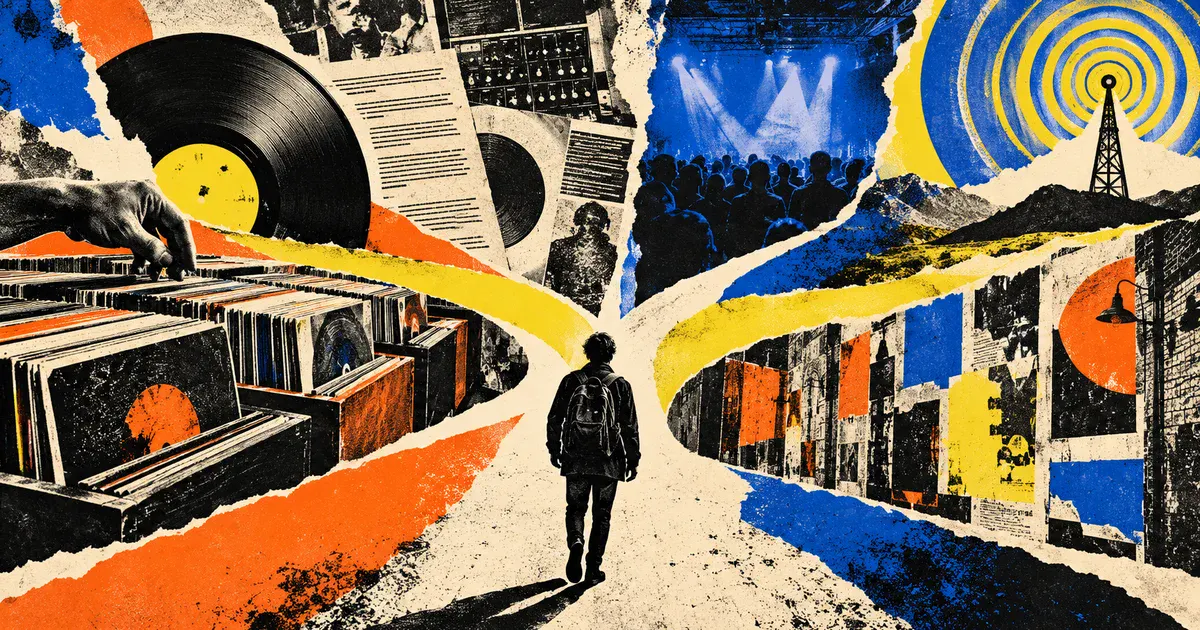
Three maps, not one
A lineage map tracks influence over time. A scene map tracks people, venues and institutions. A trait map tracks audible features such as rhythm, timbre or form. They overlap, but they answer different questions.
Arguments often happen because one person is discussing sound while another is discussing community. Label the relationship and the disagreement becomes testable.
Give every line a relationship verb. Influenced, shared members with, emerged near, uses a similar rhythmic pattern to, and was marketed as are different claims. The verb tells the reader what evidence to inspect and prevents visual proximity from implying a history you have not established. If the evidence supports only comparison, label the line sounds similar in this feature rather than upgrading it to influence.
Build a listening bridge
Choose two styles and write one contrast you can hear. Find an intermediate recording that shares one feature with each side. The bridge is useful even if nobody has historically called it a bridge; just present it as a listening comparison, not a claim of influence.
A bridge recording should make one controlled comparison possible. Choose a thirty-second passage from each endpoint and the proposed bridge, then name the exact shared feature: drum grouping, vocal timbre, harmonic loop, production texture, or song form. Also name one feature the bridge does not share. That second observation stops the middle example from becoming a vague claim that everything is connected to everything else.
Keep uncertainty visible
Use dates and credits for historical claims, and cautious language for interpretation. A dotted line can mean debated, indirect or convergent. A map earns trust by showing where its evidence ends.
Maps also need scope notes. State the years, places, source types, and musical dimension covered. A map of club activity in one city cannot stand in for the worldwide history of a genre, and a trait map cannot prove who influenced whom. Version the map when evidence changes. Keeping an earlier uncertainty visible is more trustworthy than redrawing the relationship as though it had always been settled.
Listening cues and relationships
Audible trait
Connects recordings that can be compared by ear.
Scene evidence
Connects people and institutions in a time and place.
Reliable source
Supports a claim of historical influence.
Build one listening bridge
- Choose two styles and state one audible contrast.
- Decide whether the map is about lineage, scene, or musical traits.
- Find an intermediate recording that shares one feature with each side.
- Mark any influence claim as uncertain unless a reliable source supports it.
Worked example: sound similarity without claimed influence
Imagine two styles separated by decade and geography that both use clipped guitar attacks and sparse bass movement. A third recording shares the first style's rhythm and the second style's timbre. It can serve as a listening bridge without being presented as the historical source of either.
A scene map might connect none of these recordings because their people and institutions never overlapped. Keeping the trait and lineage layers separate lets the map reveal similarity without inventing contact, ancestry, or agreement about fixed genre borders.
Where genre maps invent false certainty
Combining sound, community, and influence into one unlabeled line.
Treating a useful comparison as proof of historical contact.
Hiding disputed or uncertain relationships.
Expand the listening map
If the map is based on people and places rather than sound alone, use How to Research a Local Music Scene to document venues, bills, labels and local media.
When two recordings seem connected by musical material, How Covers, Remixes, Samples and Musical Works Differ helps distinguish a shared work, a new recording, a remix and copied audio.
Reference points and limits
These sources support the factual context used in this guide. The listening exercise and worked interpretation are original editorial guidance.
We do not claim private access, completed laboratory testing, or universal results. Read the music research and review methodology for the publication standard.