
LISTN.TO Editorial Policy
Every factual claim should be traceable to a first-party or authoritative source. Interpretation is labelled as interpretation. We do not fabricate listening tests, access, interviews, credentials, reviews, or consensus.
At a glance
Independent judgement
Payment does not buy an editorial conclusion, rating, or recommendation.
Visible evidence
Sources, assumptions, limits, and corrections stay close to the claims they support.
Publication checks
The title, H1, description, and page intent must agree. Sources must support the claim beside them, anchors must describe their destination, and the page must add a useful method, example, comparison, or original synthesis.
Docs Library entries must be finished articles assigned to LISTN.TO, not raw feeds or keyword drafts. The importer rejects thin structure, weak topical fit, missing source links, repeated passages, close matches to the existing library, unsafe HTML, and invalid images. Automated checks do not prove that every fact is correct, so corrections remain part of the publication process.
Automation boundary
Automation may collect source metadata, normalize fields, compare publication content, schedule a qualifying article, and enforce technical rules. It may not invent expertise, first-hand experience, testing, interviews, quotations, or certainty.
A large route inventory is not a publishing plan. Historical URLs remain noindex until each page has verified identity, page-specific facts, source support, and original listening guidance.
Visual and AI disclosure
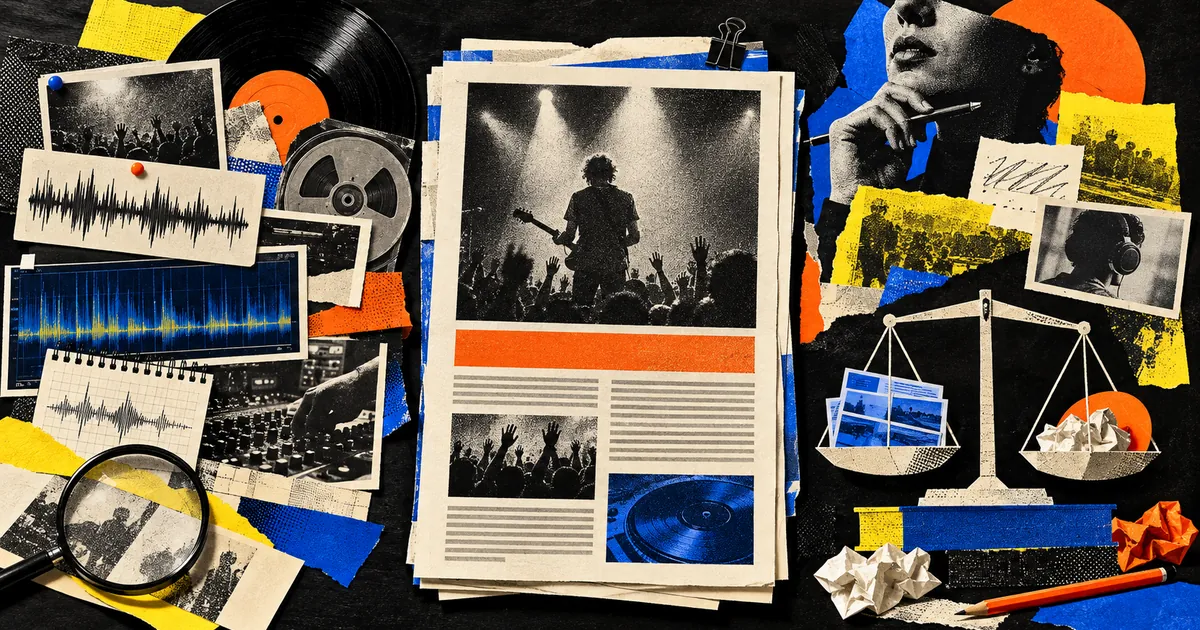
Original site artwork and social cards are generated with OpenAI image tools under LISTN.TO art direction, then reviewed, cropped, and optimized for the page. Editorial articles remain responsible for their own facts and do not present generated experiences as human testing.
Related publication standards
The practical implementation of these standards is documented in the Music Research and Review Methodology.
For a factual or attribution problem on a published page, follow the LISTN.TO Corrections Policy.