
How to Identify Album Editions, Reissues and Remasters
Edition metadata answers what you have; listening comparison answers how it differs. Do not substitute one for the other.
How do you identify the exact album edition?
Tell release, release group, reissue, remaster and remix apart before comparing sound or collecting editions.
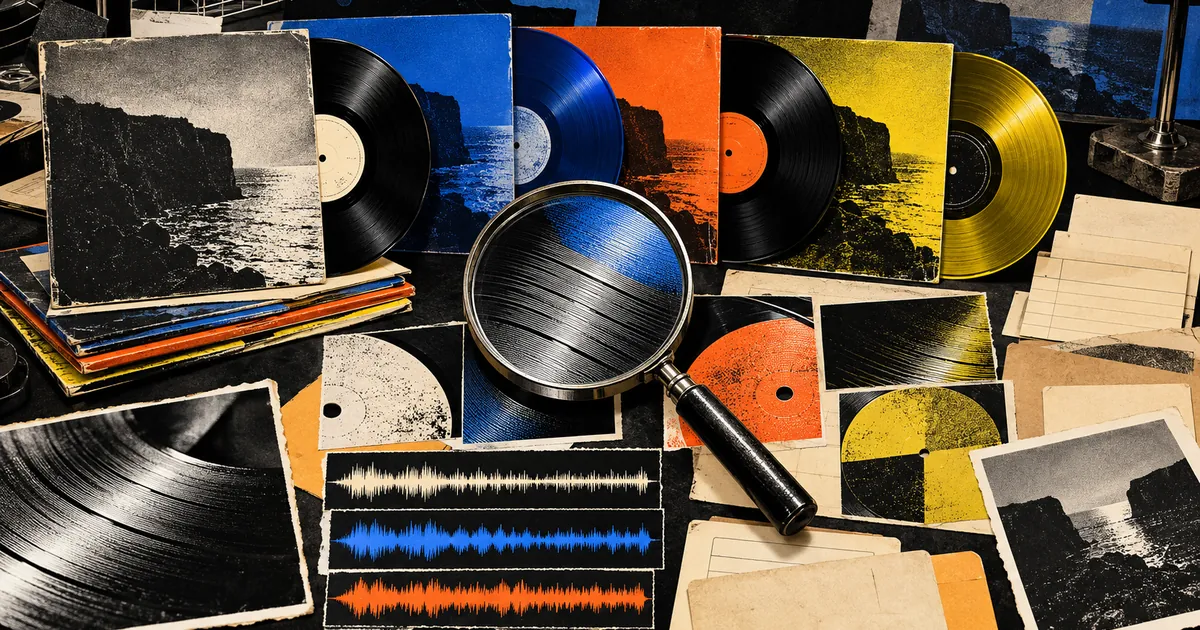
Edition identity card
- Release group title
- Edition date and country
- Label and catalogue number
- Mastering or remix credit
- Track-list differences
Release group versus release
The album concept can group many issued editions. Each specific release has its own date, country, label, catalogue number, barcode, format and track listing.
Treat the album concept and the item in hand as separate records. The release group gathers related editions, while a release identifies a particular issue with its own date, territory, label, format, barcode, catalogue number, and track list. Streaming pages often emphasize the album-level identity. For a comparison or purchase, capture the edition fields that distinguish the actual object.
Reissue, remaster and remix
A reissue is issued again and may reuse existing audio. A remaster creates a new master from an existing mix. A remix returns to multitrack or stem relationships and can change balance, effects or edits.
Marketing copy may combine these words loosely. Check credits and technical notes before assuming the scope of work.
Reissue describes a later release event; remaster describes work on an audio master; remix describes a new balance from multitrack elements. One item can be a reissue and a remaster, while another can be a reissue using earlier audio. Do not infer the process from the year, marketing image, or quieter surface noise. Look for explicit credits and compare durations or mixes when the claim is unclear.
Choose the right comparison
Collectors may value packaging, provenance or bonus material; listeners may value a particular master. State the goal before ranking editions and preserve exact identifiers in your notes.
Choose the comparison around the reader's decision. A collector may need pressing identity and packaging completeness. A listener may need source, mastering, edits, and level-matched sound. A historian may need the original sequence and territorial context. Write the criteria before choosing editions, because the rarest or newest object is not automatically the best answer to every question. Preserve the catalogue identifiers beside each listening note so the comparison can be repeated with the same releases.
Worked example: three objects sold under one album title
An album may have an original twelve-track release, a later reissue with bonus tracks, and a deluxe edition built from a new remaster. Give each release its own country, date, label, catalogue number, barcode, format, and track list. Grouping them under one artistic album concept does not make the physical or digital editions interchangeable.
Before comparing sound, determine whether the audio differs by mastering, mix, edit, source, or only packaging. A reissue can reuse an older master; a remaster can appear without bonus content; a remix changes balances or spatial decisions. State the evidence on the package or official release notes and avoid inferring process from marketing adjectives.
Entities that must stay distinct
Release group
Collects editions of the same album concept.
Specific release
Carries its own date, country, label, and track list.
New master
Changes audio without necessarily changing the mix.
Research sources and uncertainty
These sources support the factual context used in this guide. The listening exercise and worked interpretation are original editorial guidance.
We do not claim private access, completed laboratory testing, or universal results. Read the music research and review methodology for the publication standard.
Where edition labels conceal important differences
Calling every later pressing a remaster.
Using an album-level date for a specific edition.
Comparing editions before checking for different mixes, edits, or track sequences.
Check the next evidence trail
If a release contains a substantially altered recording, How Covers, Remixes, Samples and Musical Works Differ helps classify whether the relationship is an edition, remix, cover or sampled work.
Once the edition identifiers are confirmed, Remaster vs Original: A Fair Listening Test provides the level-matched procedure for hearing any mastering difference.