
How to Hear a Mix as a Moving Map
Describe where a sound sits and what changes around it before guessing which production tool created the effect.
How do you map a mix without guessing the tools?
Locate sources by width, depth, frequency and level, then follow how the map changes across sections.
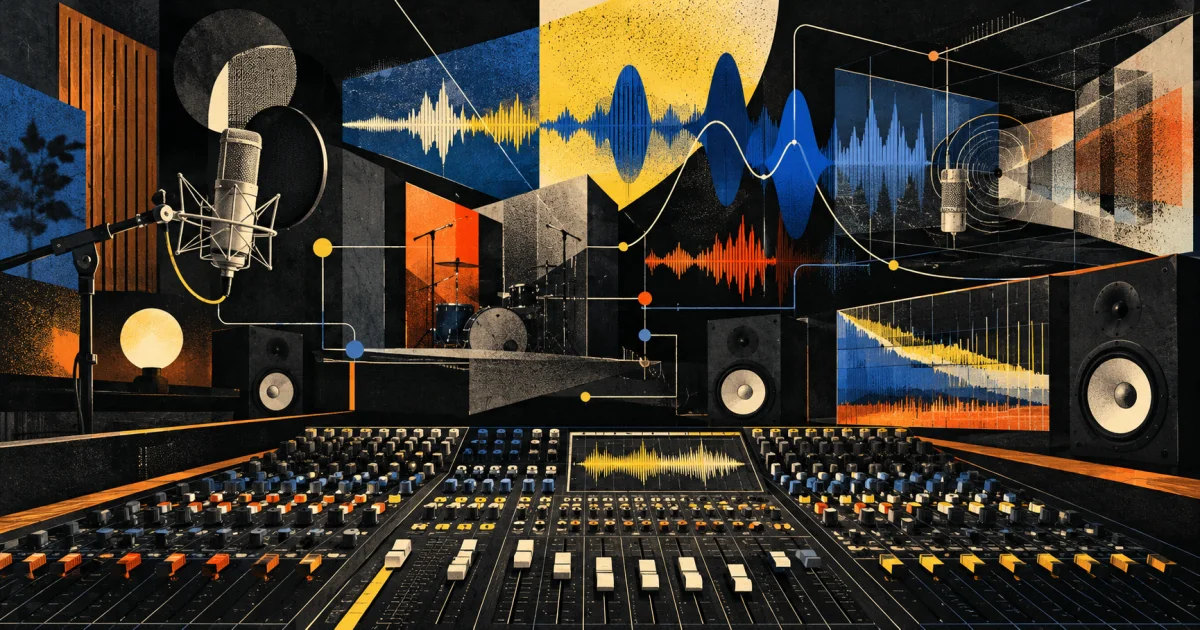
Two-section mix map
- Draw verse positions.
- Draw chorus positions.
- Circle only changed relationships.
- Explain how one change supports the song form.
Listening cues and relationships
Source position
Describes width and perceived depth.
Frequency ownership
Shows which element leads each part of the spectrum.
Section change
Moves the balance, focus, or space of the mix.
Draw the stage
Place recurring elements left to right and near to far. Use size for level and a vertical axis for perceived brightness if helpful. This is a perceptual map, not a claim about microphone positions.
Draw a simple stage for one section with left, center, right, near, and far zones. Place only sources you can identify confidently. Headphones make left-right placement obvious but do not reproduce loudspeaker crossfeed or room interaction, so treat depth and width as playback-dependent perceptions. Repeat on a second system before turning one map into a general statement about the recording.
Follow ownership
At each moment, ask which source owns the low end, rhythmic attack, center image and brightest detail. Ownership can transfer without any source disappearing.
Listen at a moderate level. Very quiet and very loud playback change frequency perception and can produce different balance judgments.
Follow which source owns attention rather than listing everything present. The lead can pass from vocal to guitar to drum fill without any element disappearing. Mark the handoff and the mix cue that supports it: level, frequency clearing, panning, ambience, or arrangement space. Ownership explains movement over time and prevents the map from becoming a static inventory of instruments.
Map automation and contrast
Compare verse and chorus maps. Circle sources that move, widen, brighten or become drier. Production often creates form by changing relationships rather than adding a completely new instrument.
Compare one verse and one chorus with the same drawing. Circle sources that move, widen, brighten, become drier, or change level. Also note what leaves, because subtraction can create impact as effectively as addition. Avoid naming a specific processor unless credits or session evidence support it. The audible result is valid evidence; the hidden technique remains an inference.
Repeat the map at a lower playback level. Elements that depend mainly on brightness or sheer level may recede, while midrange balance and arrangement relationships remain easier to follow. Do not treat the quieter pass as more truthful by default. Use it to identify which observations survive a change in level and which were tied to the first listening condition.
Where a mix map becomes speculation
Naming plug-ins or techniques that cannot be verified by listening.
Reducing every chorus change to louder or wider.
Treating headphone position as identical to loudspeaker space.
Worked example: why a chorus feels wider
Draw the verse with lead vocal in the center, guitar slightly left, keyboard slightly right, and bass and kick near the middle. In the chorus, do not merely write 'bigger.' Mark the new doubled vocal at both sides, cymbal energy across the top, and a guitar part that has moved outward while the lead remains anchored.
Then trace frequency and depth. If the chorus adds brightness and shorter, denser reflections while the verse leaves more dry space, width is only one part of the expansion. Repeat on headphones and speakers because hard panning and room interaction reveal different clues. The map describes perceived placement, not the engineer's exact settings.
Expand the listening map
When the map shows front-to-back ambiguity, How to Hear Reverb, Depth and Perceived Distance separates direct sound, early reflections and tail cues.
If the map shifts radically between listening positions, How to Test Speaker Placement in the First Hour provides a controlled first-hour setup before judging the mix.
Reference points and limits
These sources support the factual context used in this guide. The listening exercise and worked interpretation are original editorial guidance.
We do not claim private access, completed laboratory testing, or universal results. Read the music research and review methodology for the publication standard.