
How to Hear Half-Time, Double-Time and Tempo Feel
Follow the backbeat and subdivision before deciding that a section changed tempo.
How can the feel change while the tempo stays fixed?
Understand how the perceived beat can change while the underlying tempo remains constant.
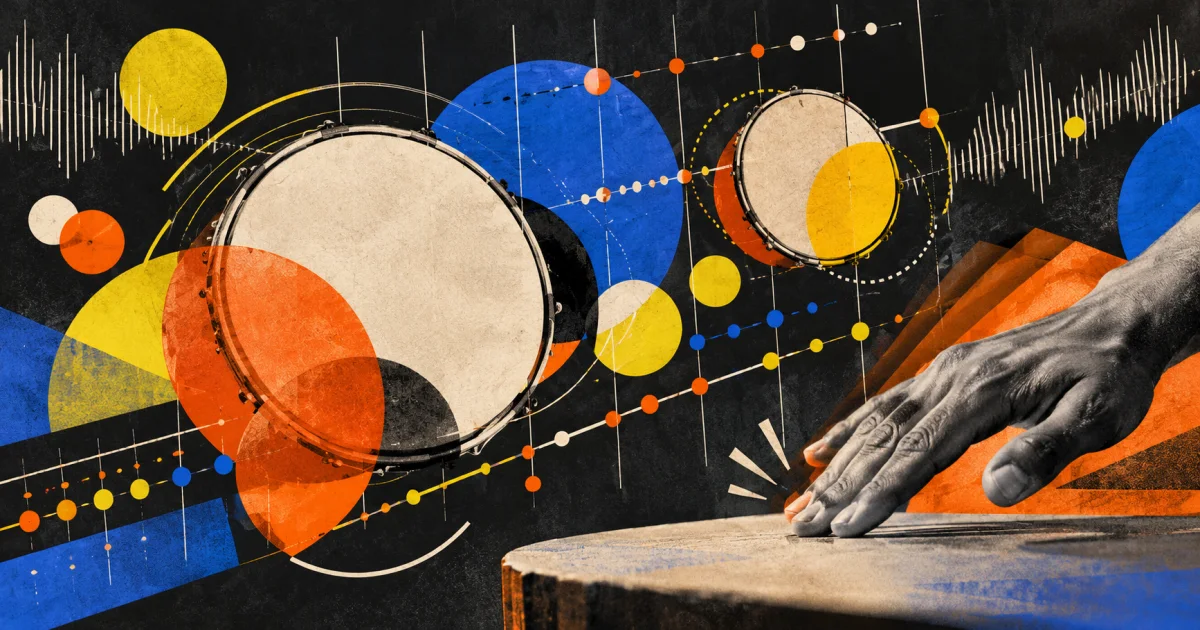
One clock, several felt layers
A track can support a slow body pulse, a middle counting pulse and a fast subdivision simultaneously. BPM depends on which layer is named as the beat.
Keep one underlying clock while testing several body movements. Tap the steady pulse, then nod on every second tap and finger-tap twice inside each beat. If all three remain aligned with phrase returns, they are different felt layers of the same musical time rather than three competing correct tempos. Name the layer you are using before quoting a number.
Hear the backbeat move
In common four-beat music, a backbeat on beats two and four supports the middle layer. A half-time feel places the strong backbeat less often, commonly on beat three, while other subdivisions may continue unchanged.
Double-time feel makes the backbeat and surrounding activity arrive twice as often without requiring the composition to accelerate.
Listen to where the backbeat and bass give weight. A shift from snare emphasis on two and four to a broad hit on three can create half-time feel while subdivisions continue at the same speed. Double-time feel can make smaller divisions prominent without shortening the song's phrases. Check melody and harmonic rhythm so the drum pattern does not become the only evidence.
Communicate the chosen layer
When sharing a BPM, add context if ambiguity matters: 80 BPM with a double-time drum feel, or 160 counted at the eighth-note layer. The number alone does not describe motion.
Communicate tempo with context: counted quarter-note pulse, half-time backbeat, or fast subdivision. This is especially important when rehearsing, programming a delay, or comparing recordings. Two people can report numbers that differ by a factor of two while moving to compatible layers. Demonstrate the tap and describe the drum relationship before treating the numerical disagreement as a listening error.
When a section changes feel, keep tapping the original pulse through the boundary. If the tap still predicts phrase arrivals while the drum emphasis reorganizes around it, the underlying tempo may be stable. If the phrase timing also changes, record that separately. This simple continuity test distinguishes a change in felt layer from an actual acceleration, slowdown, or metric transition.
Listening cues and relationships
Underlying pulse
Can support more than one felt counting layer.
Backbeat position
Changes the perceived speed of the section.
Named count
Communicates which pulse layer the BPM describes.
Three-layer tap
- Tap the slowest stable pulse.
- Add a middle clap layer.
- Speak the fastest repeated subdivision.
- Notice which layer changes when the section feels faster.
Where tempo feel gets mislabeled
Treating doubled subdivisions as an actual tempo change.
Quoting a BPM without saying which pulse was counted.
Forcing every listener or musical role onto the same felt layer.
Worked example: one tempo, three useful counts
Suppose a track has a stable pulse at 90 taps per minute. The hi-hat may articulate twice for every tap while the snare marks every second tap. You can therefore describe a 180 subdivision layer, a 90 pulse, and a 45 half-time backbeat feel without claiming that the audio file changes speed.
Choose the count that explains the musical task. A drummer discussing backbeat placement may prefer the 90 pulse; a dancer tracking broad body movement may feel 45; an editor aligning rapid cuts may use the faster layer. State the layer and evidence rather than presenting one BPM number as the only true hearing.
Expand the listening map
If the count still feels unstable after choosing a pulse layer, How to Hear Time Signatures Without Guessing tests the grouping without relying on accents alone.
When tempo feel affects a sequence rather than one track, Playlist Sequencing With an Energy Curve shows how to score perceived drive and audit the handoff.
Reference points and limits
These sources support the factual context used in this guide. The listening exercise and worked interpretation are original editorial guidance.
We do not claim private access, completed laboratory testing, or universal results. Read the music research and review methodology for the publication standard.